Sunday, March 30, 2008

Add A Little Bit Of D.E.T.E.R. To Your Life!

Now this isn't cheating, but at least it's a way to help you do the best you can on your next exam. It's the D.E.T.E.R. strategy!
D = Directions
Think about it, if you don't do the test according to the directions, there is no way for you to do well! If you don't understand, ask a teacher, they won't think less of you.

E = Examine

Examine the entire test to see exactly what it is they want you to do. This way you can break the test down into the parts that make it easier for you.

T = Time

Once you've looked over the test, decide how much time you will spend on each section.
If one section is worth more points than another, spend more time on that section.

E = Easiest
Which ones are the easiest? The ones that you know the answer to, right!! Answer those first. That way, at least you know you won't lose points if you spend time on questions that you don't know as well.

R = Review

Go over the test at the end. May be you misssed a section or a question? It's stupid to lose points from making a mistake like that. Also, sometimes teachers answer previous questions with the questions later on in the test, Hint, Hint!

This way of taking tests is an extra 5 minutes that can make a difference in your grade. If you care about your grades, think about doing it, if you don't, what can I say.

By Dardane

Saturday, March 29, 2008

Research Papers Made Easy!

Many people hear that they have to write a research paper and the become scared. The think of any way to avoid it. They copy/paste, print one of the internet, and some go so far as to buy them!! What is everyone so scared of? It really isn't that hard. To write a good research paper just be specific about your topic, know what you want to say, and say it in a way that is effective. Following these tips will help you write a good research paper.

Step 1. Choose Your Topic.
Well, this seems obvious. But it may be harder than you think. When picking a topic, choose one that you are interested in. But, make sure it is something that there is enough information for. If your topic is too broad, you won't know where to begin. You'll be that person who hands in a thirty page paper and never want to do a research paper ever again! “The Effects of Pollution” is too broad because there are so many effects of pollution. But then again, don't be too narrow. “The Effects of Pollution on Geese in the Northeast Section of Duluth, Minnesota” is too narrow. You won't find much information that is this specific. “The Effects of Pollution in Yosemite National Park” is just about right as a topic. It's like little Red Riding Hood, it has to be just right.

Step 2. Locate Information.
Use information from a variety of sources. These sources could be encyclopedias, almanacs, scholarly journals, books, magazines, and newspapers. Find these sources in print form, on CD-ROMS, or on the Internet.

Step 3. Prepare Bibliography Cards.
Making bibliography cards helps to document the sources of information you use when writing your paper. Your library will have style manuals to illustrate how to prepare bibliography cards for various sources of information.

Step 4. Prepare Note Cards.
Use note cards to record notes from each source you use when writing your paper. Number your note cards to keep track of them.

Step 5. Prepare an Outline.
Write an outline for your paper by organizing your notes from the note cards into topics, subtopics, details, and subdetails. Use an organization such as:
I.
(topic)
A.
(subtopic)
1.
(detail)
a.
(subdetail)

Step 6. Write A Rough Draft.
Use your note cards and outline to write a rough draft of your paper. As you write your draft, use numbered footnotes to credit sources from which you take quotations or major ideas.

Step 7. Revise Your Rough Draft.
Make any changes needed to be sure your ideas are clearly expressed and your writing has accurate spelling and grammar.

Step 8. Prepare Your Bibliography.
At the end of your paper, provide a list of all the sources you used to gather information for the paper. Your bibliography cards will provide this information. List your sources in alphabetical order by the first word on each of your bibliography cards.

Step 9. Prepare a Title Page and Table of Contents.
The title page is the first page of the paper. It should include the title of your paper, your name, and the date on which the paper is due. The table of contents is the second page. It should list the main topics, important subtopics, and the page on which each is introduced in your paper.

Step 10. Final Checklist.
Before handing in your paper, be sure you can answer “Yes” to each of the following questions.
Did I include a title page?
Did I include a table of contents?
Did I number all pages correctly?
Did I provide footnotes for quotations and major sources of information?
Did I include a bibliography?
Did I keep a second copy for my files?

Following these ten steps will help you write a good research paper.
By Dardane

Friday, March 28, 2008

Your TOP 20 Business Schools, outside of the U.S.

___It is always difficult to find the rankings of Business Schools. You want to choose a school that will eventually give you the thousands that you cough up, back to you at some point. The so called “payback”. School's expensive and you don't want to choose a school that one day won't allow you to get a job from it.

_____ The above list is referring to the best non-US business schools. It displays the amount of payback time, the demand of the school, the location ,the GMAT requirement and whether each school is public or private.


By Anastasia

Thursday, March 27, 2008

I'm taking a test, and I can't remember S***....

Because I am a student, I have taken exams hundreds of times! Still, every time I feel like it is the first. I feel anxious! It's like I have forgotten the material I have read; that I am going to fail! You know, all the familiar “student thoughts” before exams. If you're like me here are some ways to help keep your stress level at a minimum:


1. Arrive early. Make sure you know the where and what time your exam is. This may seem obvious but you'd be surprised how many people don't know! Get there early to give yourself enough time to settle down before the exam starts. There's nothing worse than being late for a test that you don't even feel you know what you are being tested on.

2. Be awake for the test. It doesn't matter if you drink coffee, take a NoDose, whatever, try not to be asleep when the test is in front of you. Drool on the paper doesn't add to your grade. Ideally, you would have slept well the night before and not be tired, but realistically, we all know that can’t always happen. Other options are to shower in the morning, chew gum, to have a caffeinated drink. Not too much though! Be careful when consuming caffeinated drinks, you don’t want to be jittery for the test and write like your on crack!

3. Eat a small breakfast. You’ll want to minimize any possible distractions during the test. You can't concentrate if you’re hungry. But, don't over do it! Don’t eat anything that may upset your stomach.

4. Bring extra writing utensils. You never know when your pencil’s going to break or run out of lead or your pen’s going to run out of ink. And you know that whenever you ask for a pen, nobody ever has one!

5. Bring all essential test materials. There’s nothing worse than forgetting to bring a calculator or notes to an exam that you are allowed to use them. You fell really stupid then because you can't blame it on anyone but yourself!Professors also don't usually have extras or allow you to share with another classmate.

6. Go to the bathroom. Self-explanatory. This is another precaution to minimize distractions during the test.

7. Wear comfortable clothes. You’ll want to be comfortable taking the test. If your pants are too tight and you can't breath, your test isn't the only thing on your mind.

8. Bring any necessities. Bring a water bottle, tissues, cough drops, etc. Whatever you need!

9. Look over your notes. Review important information again before the test to refresh your memory.

10. It’s just a test. Remember that you studied hard and have confidence in yourself.

By Anastasia

Four P's..You wish! Try Eleven!


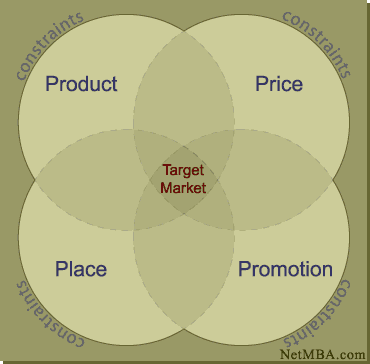
When I took my first Marketing course three years ago, I learned that the marketing mix consisted of the 4 p's, which were product, pricing, promotion and place. I think that at this point, every person who is studying marketing is soooo sick of hearing about them. As if 4 p's weren't enough, they went and added more. Was there a competition to come up with words starting with P in marketing that I wasn't aware of?? And who decided that they all had to start with P. Anyways, the P words that made the list are as follows:

People, Process, Physical evidence (Hey, does this one count, it sounds like an F), Personalization, Participation, Peer-to-peer, Predictive Modeling.
In order to help any student or any person interested, these are the definitions of the extended marketing mix:

People: Any person coming into contact with customers can have an impact on overall satisfaction. Whether as part of a supporting service to a product or involved in a total service, people are particularly important because, in the customer's eyes, they are generally inseparable from the total service.
It's like if you went into a food place, and everything was great! The food delicious, the service outstanding, everything perfect. Then you see the waiter pick their nose. I mean, that's gross to see when eating. That could make a person not want to come back. Because of incidents like this, people must be appropriately trained, well motivated and the right type of person for the job. Fellow customers are also sometimes referred to under 'people', as they too can affect the customer's service experience, (e.g., at a sporting event).
Process: This is the process (es) involved in providing a service and the behavior of people, which can be crucial to customer satisfaction.
Most things in life require you to follow a process. This was an easy add on to the p's because it can be applied in almost any situation.

Physical Evidence: Unlike a product, a service cannot be experienced before it is delivered, which makes it intangible. This, therefore, means that potential customers could perceive greater risk when deciding whether to use a service. To reduce the feeling of risk, thus improving the chance for success, it is often vital to offer potential customers the chance to see what a service would be like. This is done by providing physical evidence, such as case studies, testimonials or demonstrations.
It is hard to make something that is invisible, visible to people. This is the challenge when dealing with services marketing.

Personalization:This sounds like it has to do with people in general. It doesn't. It has to do with personalizing for people. It is customization of products and services through the use of the Internet. Early examples include Dell on-line and Amazon.com. Now, companies like Nike allow you to go online and design your own shoe. Emerging technologies will continue to push this idea forward.

Participation: This is to allow customers to participate in what the brand should stand for; what should be the product directions and even which ads to run. Some go so far as to put contests on YouTube for people to make advertisements for companies and brands. We'll keep our eye on this one and see how far it goes.

Peer to Peer: This refers to customer networks and communities. The problem with marketing is that it is “interruptive” in nature, trying to impose a brand on the customer. Marketing is your grandmother trying to force you to eat something when you aren't hungry. This is most apparent in TV advertising. These “passive customer bases”, like the television and radio, will ultimately be replaced by the “active customer communities”, which are more personal. P2P is now being referred as Social Computing and will likely to be the most effective in the future of marketing.

Predictive Modeling: This is what it sounds like. It is models that help predict the way marketing efforts will go. You know the models! If you don't, check out the Business Models for Dummies section of this blog.
And there you have it. I'm sure before you finish reading this, they have already come up for more P's for us to memorize.

By Anastasia

Do you WANT it, or do you NEED it?

What is the difference between wants and needs? Is there a difference anymore? Everyone seems to need things that at some point, they simply wanted. They now want things, that before, they couldn't imagine existing. Soon those wants somehow become needs. Whoever isn't quite sure what the difference is anymore, pay attention!! This one's for you.

A need is a basic requirement that a person wants to satisfy. As much as some people think, a product like is cell phone is not a need. It is a want that fulfills a need. I'm I confusing you. Let's start slow.
People have basic needs for food, shelter, affection, esteem and self-development. Many of these needs are created from human biology and the nature of social relationships. So, there are few real needs. Pretty much anything that keeps you physically and emotionally healthy is a need.
Now wants are things that help you fulfill needs.
Here's a basic example. I need food. Everybody needs food, right! That's the need. I WANT sushi! See i'm fulfilling the need, which is food. The want is sushi. Same goes for clothes. I Need shoes. I want prada.
Go ahead, think of some examples!
Here's some more, I need shelter, I want a mansion.
Get it? Good!
Now here comes the juicy stuff. Wants are individual. Everyone needs food, shelter, and so on. Everyone wants something different. Someone may want B.M.W. while the other wants a Jeep. What determines our wants?
Consumer wants are made by social and cultural forces, the media, and marketing activities of businesses. As much as you don't want to admit it, the things around you affect the way you think.
This leads onto another important concept - that of customer demand
Consumer demand is a want for a specific product supported by an ability and willingness to pay for it.
Oh, so here's the catch. The ability to pay for it. Everyone has unlimited wants, its the $ that makes stops you from attaining your wants. I'm sure many people would like a nice Italian car that I know, but very, very few people in the world can afford it.
Businesses therefore have not only to make products that consumers want, but they also have to make them affordable to enough people to create a demand that will make you money.
Now this one kills you when you hear it. Many people believe that Marketing creates needs. Hey, I was one of them! I got shot down and nobody could not come up with a need that marketing has come up with. Everything on the market was created because people need or want it. Can somebody sell something that is absolutely useless? If you can think of something that marketing created, please, feel free to go into the challenges section of this blog and tell us. Really, it's a challenge. Name something, anything, that we can't shoot you down with!
Now, nobody is saying that marketing is innocent. They deffinetely play around with your needs and wants. The may make an advertisement that makes you feel like you need something. But, sorry to say, they don't create the need.
So, what have we learned? May be nothing, may be alot, but hopefully you have at least understood what the difference between wants and needs. From then on, to each their own.

By Dardane


Look At Me!! I'm a Marketing Manager!!

Who wants to be a marketing manager? Do you have what it takes? Are you a follower, or a leader?
What does a marketing manager do?

Well, we pretty much know what marketing is, right? And, we also have an idea of what management is. So if we put them together? You guessed it; Marketing Manager!!

If you land the role of a marketing manager in a company, and someone asks you what you do for a living, and they look at you with a blank stare when you answer, here's a way to explain to them so they may understand.

Tell them, "I'm in charge of everything that the company does in order to attract and keep customers. I do that by finding ways to give the customer products that they want and need. Hopefully, I can do it better than my competitors and make some money for my company as well"

I'm sure they'll answer, "That's nice!"


As summed up and easy as that job sounds theres a lot more to it. Marketing management is a customer-orientated business. (which means you have to deal with the public, Ahhhhh!!!) You constantly have to do a balancing act that will make money for the company while at the same time making them look good, provide solutions to wants and needs in ways that other people haven't thought how to, and maintain a personal life. (Ha! say goodbye to personal life)

How do we go about doing this job called Marketing Management?

Over the years we have seen five ways:

1. Production Concept – consumers will want products that are available & highly affordable, & that management should therefore; focus on improving production & distribution efficiency.

Here we're talking about Henry Ford. Remember his story? Oh yeah, China's a good example too.

2. Product Concept – consumers will want products that offer the most quality performance, features, & that organizations should therefore devote its energy to making continuous product improvements.

These are those companes that every month come out with some new version of their product. Lot's of electronics and motor companies like this approach.


3. Selling Concept – consumers will not buy enough products unless the organization undertakes a large – scale selling & promotion effort.

I'm not positive if this is where Vodafone is going but it sure seems like it. I mean, with Sakis and the thumbs up, excuse me, two thumbs up, they are everywhere. From promoting soccer teams with the same red as their brand color to every billboard having Vodafone, they are going full force with their promotion.

4. Marketing Concept – determine the needs & wants of target markets & deliver the desired satisfactions more efficiently & effectively than the competitors.

Wow, this one sounds like the job description above. Which means that it is also the most ideal. Ideal meaning, hard to accomplish. This one is where it's at. If you can use this approach you got money in the bank.

5. Holistic Marketing - This one sounds like the hippie, tree huggers came up with it. In this one not only are you trying to accomplish what the marketing concept is aimed for, but now you have to take the well being of society into consideration as well. Let's throw some monkey's into the juggling act here! I mean really, not only do I have to make the company money, but I have to do it in a politically correct, ethical, and environmentally friendly way!

To me this whole matching of customer wants and needs with companies, dealing with competitors, and the whole nine yards sounds like we're in a jungle to me. The nice, happy term that scholars like to call it is the "Marketing Environment". Oh yeah, don't forget the P.E.S.T.! We also need to consider political, economic, social, and technological factors as well.
Marketing Environment! Very cute, I still prefer to call it a jungle.

So for those of you who one day decide they want to be marketing managers, take these into consideration. If this sounds scary with lots of hard work and that makes you worried, change your major to, I don't know, Psychology. For those of you who see a challenge, who see these concepts and ideas start flowing through your mind, Marketing Management is the right future for you.


By Dardane

Sunday, March 23, 2008

Mr. Michael Porter and his Five Forces for Competition


Our friend, Mr. Michael Porter has given us a diagram to explain what forces affect you or your business in regards to competition. What a nice guy!

But what exactly is he talking about?

First of all, the five forces are........drum roll.......

1.) Bargaining power of the buyer
2.) Bargaining power of the supplier
3.) Current competition
4.) Threat of new entrants
5.) Threat of new products

Does this mean anything to you? If not, lets try to make all of these make sense. Here we go, one by one.


[[ 1.) Bargaining power of the buyer

What does this mean?

Who has the upper hand? Is it you or is it your customer? In most cases, you better hope it is you! Consider the following situation.....

You own a small hotel. It's off season. Your rooms are gathering dust and the cleaning crew is bored. You get a call from a school about six hours away from your hotel saying they are going to need to book every room in the hotel the following week.

Before you get too excited.....

She is offering you less than half the amount of money from the price during the regular season. Don't forget that the little runts will drive your employees crazy, make a mess,and drive any other potential customer who would pay regular price,away.

Sorry to tell you, but the buyer in this situation has the power. She's offering you less money and a lot of hassle but it is better than nothing. You will probably accept her offer. It's not so fun for the owner when the buyer has the power.

Let's switch things up....

You still own the hotel. It is now regular season. The same teacher calls, asks for the same deal. You tell her even more money than regular and state that you are offended that she would even make that embarassing offer.

Why can you do this?

Well, you see this time your hotels busy with regular paying customers and your staff is busy as well. You would lose lots and lots of money from regular customers as well as have them complain about the amount of noise that the kids are making. The teacher, in general would have a very hard time finding a hotel that is willing to put up with the kids, let alone accept less money for doing so.
In this situation, you, the owner have all the power.

Seems simple enough, right?

2.) Bargaining power of the supplier

This one has a very simple example that should be easy to understand.

You own a business that sells coke. You and many other businesses sell coke. Many, many other businesses! The supplier has many many customers to choose from so losing you isn't really that important to him or her.
In this case....the supplier has all the power.

Flip it around now.
You order soda from a supplier that has only you and one other business as customers. If you leave him or her, they are pretty much screwed because then they will lose half of their business.

In this case, you have the power, not the supplier.

You see, if you are one of many customers for a supplier, the suplier has the power, if you are one of a few customers for the supplier, you, the business, have the power.

3.) Current competition.

What's this?

Really, C'Mon!!!! Current competition! What does current mean? What does competition mean? Ok now, put them together. If you still need help...
Current competition is the people or businesses that you are in competition with, right now.

4.)Threat of new entrants

What does Mikey mean?

Well, you have current competition, those are who you are competing with right now. We covered that just a second ago. New entrants, however, is who else is going to come on by and also be your competition. Is there a threat for new entrants constantly, or are there barriers set up either by you or naturally? Are you easy to copy? These are only a few of the consideration when determining your level of threat for new people coming in trying to steal your market share.
Last but not least......

5.) Threat of new products

What does this mean?

This is beyond people copying you or becoming just regular competition, this is replacing you with something else.

A good example, where did beepers go???

If you remember beepers, they were used for paging people so that they knew that they needed to call you back.
Cellular phones came out and kinda made beepers useless. This is a perfect example for understanding how bad of a threat a new product may be. It may mean, extinction of your product!

These, my friends, are the wonderful additions to our knowledge of business competition Michael Porter bestowed apon us. Hopefully, we are all grateful that he figured out these forces to competition and shared it with us so that we are more capable of understanding what we will face in the business world. Thank you Mr. Porter!!


[+/-] More.../less

By Maria

Friday, March 21, 2008

P.E.S.T., P.E.S.T.E.L., P.E.S.T.E.L.I., In the end it's all the same!


At some point in either your student or professional career you may and probably will have to make a P.E.S.T.E.L. (or any variation of the acronym) analysis in order to understand very important information pertaining to your business, either in a realistic situation or in an educational scenario.

First of all, what does P.E.S.T.E.L.I. stand for?

P, stands for political.

Why do we care?


[[ Whether you are deciding on opening a business at home or abroad, you must be aware of the political situation. For example, you may have a paper to write for one of your classes. The topic is to decide which country you would like to expand your business to. You don't do a P.E.S.T.E.L. You choose Cuba as your country. You then look like an ass. Why? Because if you had done your P.E.S.T.E.L., you would see that Cuba is a communist state. It may be hard to enter into a market that has a communist regime, don't you think?


This is a very basic example for a very important aspect of the P.E.S.T.E.L. Remember that when you are focusing on the P., of the P.E.S.T.E.L., you focus on the political regime and its regulators in relation to your particular business. You see how stable the situation is in the particular country as well as whether or not the information in the political aspects has relevance to your business. Don't focus on information that is useless! Not so hard so far, right?

E, stands for Economic.

Why do we care?

We study business right? Well, people having money to spend may, just may, be important to us. If we are going to open a business, realistically or hypothetically, we need to see whether the area, city, state, or country has the ability to give you money. Here we focus on G.D,P's, average household incomes, value of currency, industry trends, anything that has to do with $$$.


Example, (because we all love examples) if I want to open a branch in the real estate market in the United States today, it may be a bad idea. I might have to do a P.E.S.T.E.L. to realize that interest rates are terribly high, people are losing their homes, and the country is about to go into a recession. This information, once again, may be important to us. So far, so good!


S, stands for social.

Isn't this a fluffy aspect to look at. Social sounds cute doesn't it. Cute, it may be, but also very important when deciding to open a business. When we look at the social situation in a country we see whether or not our product or service would be accepted and successful in a particular area.


Example, If I decide to sell guns in Massachusetts, I may not be very successful. The second ammendment isn't really focused upon there. If I decide to sell guns in Texas though, I probably will have a much more successful outcome. This is one small aspect of the Social section of a P.E.S.T.E.L. Here we focus on culture, demographics, change, etc. It is very important to relate this area to your specific product or service. If you want to introduce a new car in a particular area, it is irrelevant whether the national passtime is playing football. Stick to the relevant ideas and you'll be fine.

T, means Technology

Why do we care?

Maybe it's just me, but this day and age technology seems to play an important role in every day life. The level of technology that is available to an area of your choice should be taken into consideration. You should already know I'm going to give you an example.

If you want to sell cell phones in China with the technology that is available in Europe, you may run into some problems. You see, Chinas technology, in reguards to cell phones, is far beyond the technology that has been developed in Europe. In the technology aspect of a P.E.S.T.E.L., you focus on the level of technology that is present in your area, meaning, how advanced is the area you are choosing? Do they send letters through the mail or do they email? Do they hand write or do they type? These are are few suggestions in determining what to focus on in this section. As always, you add information relevent to your product or service!

E, means Environment

Why do we care?

Are we talking about bunnies and bears? No! We are talking about things like clean water and air. Can I build a factory there without having Greenpeace up my butt? You understand where I'm going with this, right?

In the Environment section of the P.E.S.T.E.L. you focus on environmental issues relevant to your business. As stated before, having clean air and water might help my employees while they are working. Once again, if the manatee is endangered there, it probably isn't important, unless I decide to open a factory that dispenses toxins into the water where manatees live. This isn't that hard, I'm sure you'll do fine understanding what to put in this section.

L, stands for legal or legistative.

Why do we care?

This is the section that keeps the police out of our backyard and ourselves out of court proceedings. Depending on what business you are in and where, you must be fully aware of the legal situation there. You must know all the legislation in order to keep yourself from breaking the law.

Example, If you are doing business in a muslim nation, and you are not aware of the laws pertaining to Sharia, you just might run into problems. As in every other section of the P.E.S.T.E.L. you focus on legislation that pertains to you or your business.

Under normal circumstances you would be done with this analysis, but I have had the joy of an instructor who added another letter. Just in case you also run into an instructor who also feels this letter to be important, or if you would like to be more in depth for your business this letter is for you!

I, stands for Infrastructure.

What is Infrustructure? Picture a city. The roads, the water and sewer pipes, the telephone, cable, and electric wires, on and on and on, is the infrustructure.

Why do we care?

Here is a beloved example. If I want to introduce cable television and internet to Greece, I will, not may be, run into a problem. You see, Greece's infrustructure does not contain cable lines suitable to withstand full cable television and internet.

This is a small example of many that could be given that makes the infrustructure section of the P.E.S.T.E.L. very important. If your business requires trucks to deliver you supplies, make sure the area has roads! If you want a call center, make sure there are telephone lines!

This my friends, is a full P.E.S.T.E.L.I. analyis and how it is applied. I pray, nobody still has questions and hopefully this helped some of you. ]]


[+/-] show/hide this post

By Maria

Thursday, March 20, 2008

Grab a Coffee, It's Last minute Studying Time!!


Unless times have changed and I wasn't aware, most students who will even bother studying, will do it either the entire night prior to the exam of even the hours before the exam. While you're studying you tend to think, "Damn, I should have probably started studying earlier than this!" But every time, the book opens the night before. As much as the following goes against our nature as students, here are some ways I feel, ease the pain of studying.

In order to avoid frustration of last minute studying, I always make a “things to do” list. I write down every deadline of the projects, assignments, mid-terms, and final exams that I have. This can certainly help a student manage their time. It also has the extra benefit of clearing your mind and saving you energy and stress.

I've found that if I spend 5-10 minutes each day on planning my activities with a daily to do list, I get a lot more done within that day. Give it a try! It sounds corny, but it works. Even better, every night, write a plan for the next day, listing your daily things to do. It is important that you actually write your tasks. That way you have a hard copy to see whether you decided to be lazy or actually accomplish the tasks you set for your day.
Nobody said that you have to write this list on paper, use your computers, cell phones, whatever you have. Try and see what works better for you. After you've listed what you want to do during that day, go over your list and put what is most important first; prioritize the list. Give higher priority to the tasks that get you closer to your goals.
One important tip to keep in mind!
If during a day some new unplanned task comes up, don't do anything until you put that new task on your list and rate it by priority. See it written along with the other things to do and put it in perspective. Once again, sounds corny, but do it, it helps!
Also don't forget, when making a to do list, break down your harder tasks into smaller manageable pieces, and focus on them one at a time.
Finally, after completion of a task take a moment to look at the result.
Did you get what you wanted to get done that day?
If you did, pat yourself on the back! You have written proof that you weren't useless that day!
If not, you have written proof that you are lazy!
You will see that if you organize yourself you will have time to study just a little bit so that when it comes time for the test, at least some of the things that you studied, stuck in your mind.


By Anastasia

Thursday, March 13, 2008

Does Marketing Create Needs?


This question was asked in a few of my classes by the same professor in order to see how the students would react. Many of the students answered yes. The professors answer was no, Marketing answers to needs that already existed. Many of the students became frustrated and passionate in finding a need that was created by Marketing with no success. This is your challenge: Find a need that was created by Marketing. There has to be at least one. If we put our minds together we can think of one! Can’t we? Remember, peoples needs are not just food and shelter, we also have egos to cater to! A need created by marketing means that something of absolutely no use, has the ability to gain usage because marketing tactics were administered. If someone has the ability to come with with a need that the Professor cannot detest to, they will receive recognition for outsmarting our professor.

By Maria

What Marketing actually is?


I, like many, many other young adults in Greece, study Marketing. I begun having an interest in Marketing because of a fledging career in Real Estate. I figured in order to help advance myself, I would take a Marketing class. I realized from that class the impact that marketing has on our everyday lives, found it interesting, and decided to pursue it. For personal reasons I decided to move to Greece and obtain a degree in Marketing from an American University of some sorts. Upon arrival people began asking me about why I came and so forth and the conversation always led to what I was studying. I would relpy Marketing, and would have the classic reaction, “ohhh, you too”. I had no idea, but eventually found out, that far too many students in Greece studied Marketing. As classes and time passed by I noticed that all though so many students studied Marketing, very few people actually knew what Marketing was. It was until recently that I was able to put together a full definition for explanation.

This is the challenge:

Write out what you feel, is the full definition of what Marketing actually is. Don’t cheat! Challenge yourself! The person with the definition and or the closest definition will be given recongition for their ability to define EXACTLY what it is that they are studying.

By Maria